Review: Thermalright Peerless Assassin 120 SE
A brief review of the Thermalright PA120SE (non-RGB) on the AM4 platform.
I have been using BeQuiet! Dark Rock coolers for over a decade now. From Ivy Bridge and Haswell, all the way to AM4. They provided an aesthetically pleasing and cost-effective alternative to Noctua coolers, sitting between the NH-D15 and U14A in performance, for U12 price (AUD). The build quality and included fans are great and generally free of annoying motor hums or noticeable beat frequencies. The game has since changed and Thermalright has entered the market globally, competing fiercly with just about everything.
I needed to buy a new cooler for a project, so I thought I would pass on my trusty BeQuiet! Dark Rock 4 for said project, and try out one of these new fandangled Thermalright coolers. Before taking this as gospel (though it is seemingly the only Dark Rock vs PA120 comparison on the internet), please read through the methodology and control section before heading to the results!
Methodology
I will only be testing with three applications, and I have kept them relevant to my general workload. In all cases, the tests were ran for as long as necessary to reach thermal equilibrium.
Handbrake Transcoding
This test consists of transcoding a 30-minute 4k60 video to 1080p60 to represent a creative, non-AVX workload. Because not every core is fully engaged, it pushes the frequency and voltage quite high making this a thermally difficult scenario over the long periods of time that batch processing typically goes for. The settings for the transcode are as follows:
- Encoder: x264
- CRF: 20 @ Slower Preset
- Framerate: Same as source + Constant
- Color Range: Same as Source
- Profile: Main, L5.1
- Audio: AAC Passthru (320kbps)
Aida64 CPU + FPU
Serves as a reasonable thermal stress-test, without resorting to the likes of Prime95 or other heavily-AVX’ified workloads which aren’t really representative of my workloads.
Gaming (Forza Horizon 6)
Representative of a general gaming workload.
System Specifications
- CPU: AMD Ryzen 9 5900X
- CPU Cooler: Device Under Test (BeQuiet! Dark Rock 4 vs Thermalright PA120SE)
- Memory: Corsair Vengeance RGB Pro, 2x16GB, 3600MHz
- tCAS 18, tRCD 22, tRP 22, tRAS 42, tRC 84, tRFC 630, CR 1T
- FCLK & MCLK = 1:1
- Motherboard: Asus Strix ROG X570-F, BIOS Version INSERT BIOS & MICROCODE VERSION HERE
- SSD: Samsung 990 Pro 2TB
- GPU: Gigabyte RTX 4090 Gaming OC
- Case: Corsair 4000D
- PSU: Corsair RM850
- Operating System: Windows 11 Home, Build 22631
Controls & Considerations
!!! Testing was performed with different thermal pastes !!!
The Thermalright PA120SE was installed with Arctic Cooling MX-7 thermal paste, while the baseline runs with the BeQuiet! Dark Rock 4 were conducted with 6-month old Arctic Cooling MX-6. This alone should account for a 1-2C difference in temperature, if MX-6 vs MX-7 reviews and product marketing is to be believed.
- CPU is running stock settings, that is PPT = 145W, TDC = 95A, EDC = 140A. No PBO or CO have been applied.
- Ambient temperature was not explicitly measured, but the PA120SE results were taken right after baseline to minimise deviations.
- Haven’t noted driver versions, not entirely important for this test so long as they remain unchanged between the baseline and new cooler.
- The Handbrake and Aida64 tests were conducted with the side panel off to try and remove the case as a limiting factor. It was put on for the gaming tests to see the interaction between the heat dumped by the GPU with the CPU cooler.
- Case fan speeds were not fixed at the same speed between runs, but the fan curve is pretty flat anyways.
- The CPU cooler fan speed was fixed to equate noise levels.
- Noise levels were by ear and thus subjective, based on sound signature / harshness as well as perceived loudness. I can’t offer much more than a “trust me bro” with this, sorry. If I do more of this review stuff, I might include some recorded sound samples!
Results
Baseline (BeQuiet! Dark Rock 4)
| Application | Temperature (Tctl) | Temperature (Core) | Package Power |
|---|---|---|---|
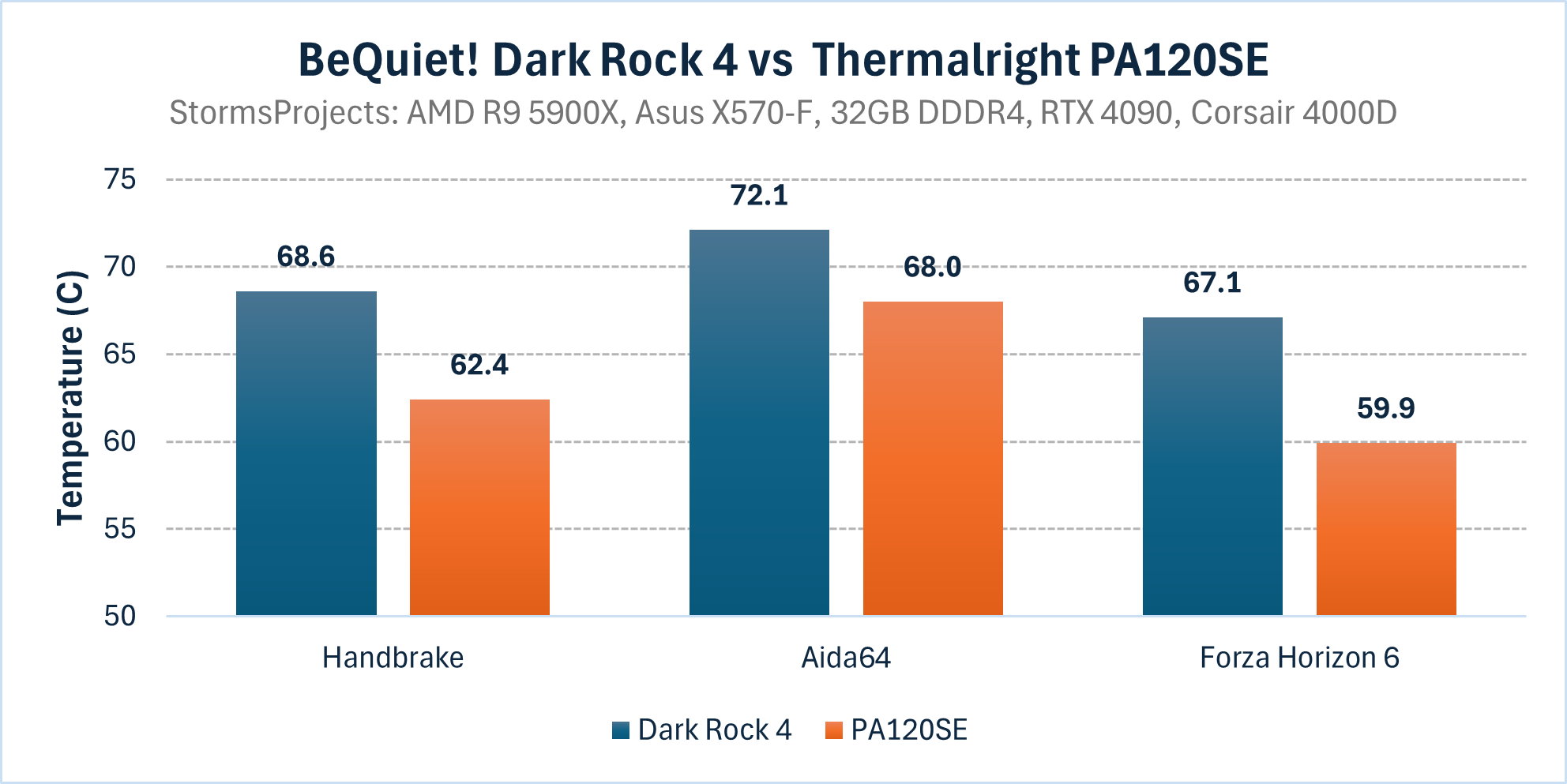
| Handbrake (x264) | 68.6 C | 62.6 C | 145.2 W |
| Aida64 CPU + FPU | 72.1 C | 64.5 C | 145.0 W |
| Forza Horizon 6 | 67.1 C | 59.3 C | 122.3 W |
Thermalright PA120SE
| Application | Temperature (Tctl) | Temperature (Core) | Package Power |
|---|---|---|---|
| Handbrake (x264) | 62.4 C | 58.4 C | 145.6 W |
| Aida64 CPU + FPU | 68.0 C | 59.8 C | 142.3 W |
| Forza Horizon 6 | 59.9 C | 52.1 C | 116.3 W |
Comparison (Tctl)
Other thoughts
The good:
- The mounting system is simple and good quality, especially for the price.
- Pictures in the instruction manual were clear and descriptive
- The bags containing the mounting hardware are labelled for their respective platforms, no guessing needed.
- Included PWM fan splitter (2-to-1) is welcome for this price point
- Noise levels are great with no weird motor hum or overlapping frequencies. Not as good as the DR4, but I would probably forget about it by tomorrow.
- Tons of room near the EPS12V power connector, no issues accessing that cable after installation.
- Compact height leads to great case compatibility.
- More room between the GPU and cooling towers so I won’t need to carefully position a screwdriver to unlatch my GPU anymore.
The not-so-good:
- Was really hoping for better RAM clearance, the front fan completely covers DIMM slots 2 and 3 so it is raised about 20 mm on the tower. It’s still shorter than the DR4 though, which only overhung DIMM slot 1.
- The cooler itself is much flimsier than the DR4. Functionally irrelevant though, and nothing unexpected for the price. e.g. trying to clip the fans in to the cooler, or squeezing my hand between the cooler and the case to plug them in had me slightly worried I was going to break something.
Conclusion
Thermalright did a great job on pretty much everything with this cooler. Any arguments or objections are simply met with the $42 that I paid for it, where historically this kind of performance was dedicated to ginormous, $150+ AUD coolers with fans that when purchased standalone, exceed the cost of the PA120SE on their own.
And unlike cheap coolers of old, the mounting system is solid and just as intuitive and easy to install as other manufacturers (thank god). The fans don’t sound like they’re going to die past 40% PWM. The included tube of thermal paste is actually sizable, and the accessories and hardware are well-labelled.
I’ll be happy to continue using Thermalright coolers from now on, and would love to experiment with the performance difference using higher quality fans. Arctic P12 Pro’s come to mind.
Overall, 8.5/10.